
Somewhere right now, a 26-year-old with an iPhone and a Ring light is outmarketing your brand. Not because they have better products. Not because they have a bigger budget. Because they understand something most businesses still haven't internalized: attention is the asset, and short-form video is the most efficient way to earn it in 2026.
Short-form video — content under 60–90 seconds on TikTok, Instagram Reels, and YouTube Shorts — now accounts for 43% of all social media content consumed globally. YouTube Shorts alone is generating 200 billion daily views. TikTok will convert 45.5% of its users into buyers this year — the highest in-platform purchase conversion rate of any social network on earth.
And yet most brands are either absent, inconsistent, or producing content that gets skipped in under a second.
Short-form video doesn't work because it's trendy. It works because it's engineered — deliberately or not — around how the human brain processes information, seeks reward, and makes decisions. Understanding this is what separates brands that grow on social from brands that just post.
Humans make a watch-or-scroll decision in under 3 seconds. That's not a social media stat — that's cognitive science. Our brains are constantly filtering stimuli for relevance, novelty, and threat. A video that opens with a logo or a slow pan loses. A video that opens mid-action, with a bold claim or an unresolved question, wins. The hook isn't part of your video — the hook IS your video. Everything else is just delivery.
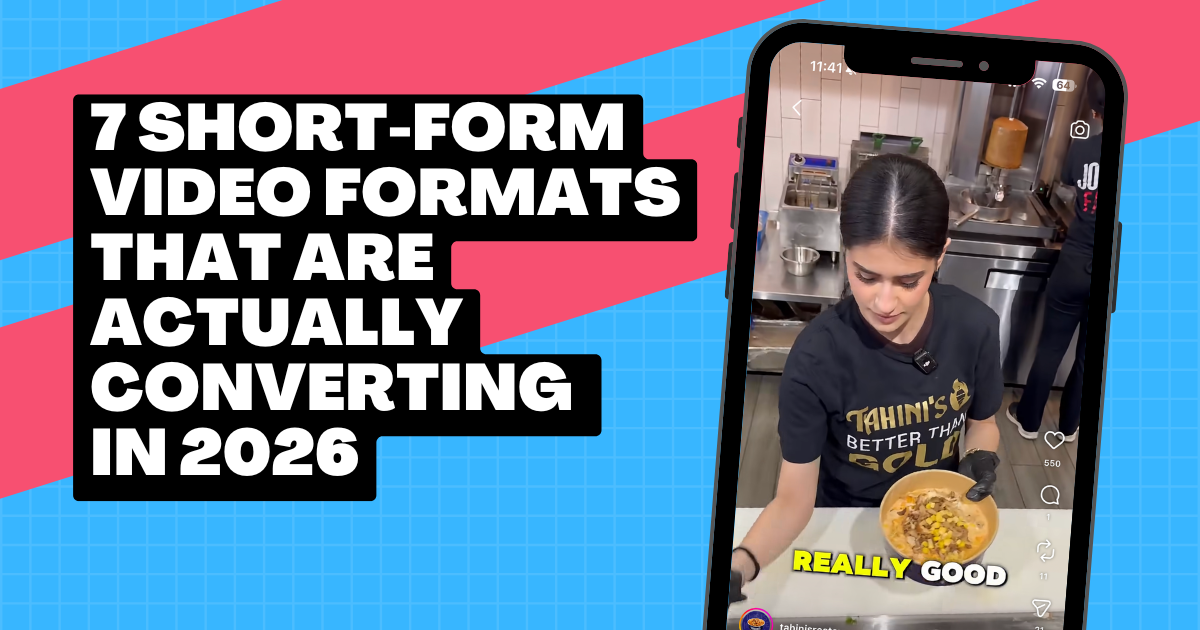
The Zeigarnik Effect — a well-documented psychological principle — shows that humans are wired to seek closure on unresolved loops. Open a video with an unfinished question ("The one thing Tahini's did that took them from 0 to 1M TikTok followers...") and the brain literally cannot scroll away cleanly. It needs the answer. This is why the best short-form hooks aren't descriptions of what's coming — they're open wounds the viewer has to watch to close.
Social video feeds are slot machines, and they're designed that way on purpose. The unpredictability of what comes next — funny? inspiring? surprising? — releases dopamine on anticipation alone. When your content delivers a genuine emotional payoff, users don't just watch. They come back. The average consumer now spends 17 hours per week watching online video. Your content is competing for a share of that time, against every creator and brand on the platform.
The brain rapidly habituates to repetitive stimuli — it's a survival mechanism. Quick cuts, jump cuts, text overlays, sound effects, and sudden visual contrasts all serve the same function: they reset the viewer's attention before it drifts. This is why strong short-form content changes visual stimulus every 2–3 seconds. Not because it looks cool. Because the alternative is losing the viewer to their own wandering mind.
The most quietly powerful element of short-form video is social proof at scale. When someone sees a person like them — same city, same lifestyle, same problem — reacting genuinely to your product, the psychological barrier to purchase collapses. In 2026, 92% of consumers say they trust user-generated content more than any other form of advertising. Your best marketing asset isn't your next campaign. It's your happiest customer with a phone.
Here's the state of short-form video in 2026. These aren't projections anymore — they're ground truth.
The fundamentals of short-form video haven't changed — psychology doesn't have a version update. But the landscape has shifted in ways that matter for how you execute.
The "shorter is always better" rule is over. TikTok videos over 54 seconds now average roughly double the views of sub-10-second clips. YouTube Shorts between 50–60 seconds get the most platform views. Instagram Reels peak at 60–90 seconds for engagement. The platform algorithms have matured — they reward watch time and completion, not just brevity. Your content should be exactly as long as it needs to be to deliver real value. Not longer. But don't cut for cutting's sake.
94% of marketers plan to use AI in their content creation in 2026. The smart ones use it for the repeatable, low-creativity work — scripting first drafts, generating captions, suggesting B-roll, creating format variants for different platforms. The dumb ones use it to replace creative direction entirely and wonder why everything looks the same. AI gives you speed. Human creativity gives you differentiation. You need both.
70% of video marketers now use LinkedIn — the most widely used platform for video marketing, period. 97% of LinkedIn videos are vertical and smartphone-shot. B2B founders who show up on TikTok and YouTube Shorts are generating inbound pipelines that cold outreach can't touch. If you're a B2B brand sitting this out because "our industry isn't really a TikTok industry," you're not watching what your competitors are quietly building.
The brands winning in 2026 treat short-form content like a product, not a post. A repeatable series — same format, same energy, same time slot — trains your audience to return, makes content easier to produce, and builds compounding brand recognition over time. One tip per week. One myth debunked per Thursday. One behind-the-scenes every Monday. Pick a lane, run it for 90 days, and measure.
Not all platforms are the same. Here's how to think about each one — and where to start.
TikTok's interest graph serves content based on behaviour, not follower count — meaning a brand-new account with zero followers can reach 100,000 people with the right video. It holds 40% of the short-form market and converts 45.5% of users into buyers. TikTok videos with captions see a 95% boost in brand affinity, 58% increase in recall, and 25% jump in perceived uniqueness. Lead here. Post 1–3x daily if you can. Raw and authentic beats polished every time.
Instagram has the highest average session time of any short-form platform at 53 minutes. 57% of Reels viewers discover new brands through the feature — and 61% of marketers report it as their strongest-performing video platform. The audience expects slightly more polish than TikTok, but not much more. Think behind-the-scenes, product demos, transformations, customer moments. Aim for 60–90 seconds. Post 4–5x per week.
YouTube Shorts is the sleeping giant. 200 billion daily views. The highest engagement rate (7.91%) of all short-form platforms. And critically — Shorts are indexed by Google and surfaced in AI answer engines, meaning a video you post today can generate traffic for years. If SEO and AEO matter to your business (and they should), YouTube Shorts is where you build your evergreen library. Aim for 50–60 seconds. Answer one specific question per video.
70% of video marketers now use LinkedIn — more than any other platform. 97% of its videos are vertical, shot on phones. If you're in professional services, SaaS, consulting, or any B2B category, LinkedIn video is currently one of the most underpriced attention channels available. Show up as a founder or expert. Be specific. Be human. The bar for "good" is remarkably low, which means the upside for "great" is enormous.
Strategy is worthless without execution. Here's a practical framework for producing short-form video that works.
Before you script anything, write the first 3 seconds. If you can't make those 3 seconds stop a scroll, the rest of the video doesn't matter. Test 3–4 hook variants on the same concept before you scale production.
50% of short-form video is watched on silent. Caption-free videos lose half their audience at the jump. On TikTok specifically, captioned ads see a 95% lift in brand affinity. This is not optional.
Give something real — a tip, a laugh, an insight, a behind-the-scenes moment — before you ask for anything. The CTA (follow, DM, click the link) should feel like a natural next step, not a sales pitch.
Pick one repeatable format that fits your brand. Run it consistently for 90 days. Measure watch time and completion rate — not likes. Iterate from there.
Let AI handle first-draft scripts, caption generation, and format repurposing. Keep humans in charge of the hook, the voice, the creative direction, and the final call. The brands that win with AI are the ones using it to go faster — not cheaper.
Most video agencies think about production. We think about psychology first, platform mechanics second, and production third. The camera is just a tool. The strategy is the product.
We've generated over 1 billion social video views for clients across North America, completed 1,000+ projects, and helped brands like Tahini's go from zero to 1M+ TikTok followers and 3.2M+ YouTube subscribers. One of our most-referenced client examples — a DataCandy video shot entirely on an iPhone in under 30 minutes — outperformed content that cost 10x more to make.
We work with businesses across Canada and beyond to build the content engine — the hook strategy, the production cadence, the platform distribution, the measurement framework — that turns short-form video from a thing you occasionally post into a compounding growth asset.
Q: How long should my short-form videos actually be in 2026?
A: Longer than you think. TikToks over 54 seconds average nearly double the views of sub-10-second clips. Reels peak at 60–90 seconds. Shorts perform best at 50–60 seconds. The algorithm in 2026 rewards watch time and completion rate — not just brevity. Make it as short as it needs to be to deliver real value. Then stop.
Q: How often do I actually need to post?
A: Often enough to feed the algorithm and build audience memory. Daily on TikTok if possible. 4–5x per week on Reels. 3–5x on Shorts. If that feels like too much, start with 3–4 total per week across platforms and build from there. The brands posting 20 times a month consistently beat the brands posting 5 times perfectly.
Q: Do I need professional equipment?
A: No. You need good audio, good lighting, and a good idea. Bad audio kills engagement faster than anything else — even a $5 lav mic makes a difference. Natural window light beats most studio setups. The rest is creative direction, which has nothing to do with gear.
Q: We're a B2B company. Does short-form video actually work for us?
A: Yes, and 2026 is the proof. 70% of video marketers now use LinkedIn. B2B founders showing up authentically on TikTok and YouTube Shorts are generating inbound pipelines that cold email can't replicate. 61% of B2B marketers plan to increase video investment this year. The psychology is identical regardless of industry — people buy from people.
Q: What metrics actually matter?
A: Watch time and completion rate first — these tell you whether your content is working at the content level. Then engagement rate (shares and saves matter more than likes). Then follower growth rate. Then downstream conversions — DMs, link clicks, purchases. Don't optimize for vanity. Optimize for watch time and let everything else follow.
Q: How does short-form video help with Google search and AI answers?
A: YouTube Shorts are indexed by Google and increasingly pulled into AI answer engine results on Perplexity, ChatGPT, and Google's AI Overviews. Pages with embedded video are 53x more likely to rank on Google's first page. Short educational videos that answer specific questions directly are the most AEO-optimized content format available right now — which is why YouTube Shorts should be part of every content strategy that cares about search.
In 2026, short-form video isn't a trend to watch. It's the default format for how brands earn attention, build trust, and drive purchases. 200 billion daily Shorts views. $111 billion in ad spend. 45.5% purchase conversion on TikTok. The numbers are settled.