The average TikTok user scrolls past content in 1.7 seconds if it doesn't hook them immediately. That's not a attention span problem. That's a creators-don't-know-when-to-shut-up problem.
Most brands approach content like they're writing a novel. They add context. They set the scene. They explain the setup, the product, the benefit, and the call to action.
By the time they get to the point, the viewer is already three videos deep into someone else's feed.
The best creators don't do this. They delete everything that doesn't directly serve the hook, the payoff, or the conversion. They know that every extra second is a chance for the viewer to leave.
And in 2026, when short-form video is the primary way brands reach new audiences, that discipline is the difference between content that compounds and content that dies in the drafts folder.

Here's the framework that separates high-performing content from everything else:
The moment your audience understands the purpose of a shot, a line, or a transition — cut to the next thing.
No lingering. No extra beats for "cinematic feel." No holding on a product shot because it looks nice.
This isn't about being abrupt. It's about respecting the viewer's time and the platform's algorithm. Instagram Reels, TikTok, and YouTube Shorts all reward watch time and completion rate. If you lose someone halfway through because you padded the middle, the algorithm buries the video.
Practical example:
Instead of:
Do this:
You just turned a 15-second video into a 7-second video that performs better because it moves faster than the viewer's thumb.
In 2026, creators are still obsessing over gear. They're debating whether to shoot on a Sony A7S III or a Canon R5. They're comparing frame rates and codecs and lens sharpness.
Meanwhile, Olivia Rodrigo shot a music video on an iPhone 15 Pro that ran on rotation across streaming platforms.
The camera is the least important thing on set.
What actually matters:
According to HubSpot's 2026 State of Marketing Report, 73% of consumers say they're more likely to engage with video content that feels authentic over content that looks overly polished. That means you don't need cinematic production. You need good fundamentals.
Lighting and storytelling are skills, not budget lines. You can build both with a couple of softboxes, a backdrop, and props from your local craft store.
Illustrative data based on creator feedback and platform performance benchmarks. Shows relative importance of production elements.
The chart makes it clear: camera specs rank dead last. Focus on the things that actually move the needle.
A product spinning on a white background isn't content. It's a placeholder.
Even the shortest video needs to say something. Not in a verbose, brand-manifesto way. In a this-solves-a-problem or this-makes-you-feel-something way.
Here are the narrative devices that work in 2026:
Problem/solution framework
Show the pain point in the first second. Show the product solving it in the next two. End on the outcome.
Example: Mess on the counter (1 sec) → product in action (2 sec) → clean result (1 sec). Done.
Mystery/reveal structure
Present the product as an enigma. Build curiosity. Resolve it with a payoff that makes the viewer feel smart for watching.
Example: "Why does this look like that?" → close-up of unexpected detail → reveal of full product and its unique benefit.
Transformation arc
Before/after, but faster. Show the change, not the process.
Example: Dull product shot → one lighting tweak → professional result. The whole thing takes four seconds.
Every frame should be doing work. If it's just pretty but not purposeful, it's dead weight.
The biggest mistake brands make with social ads is making them look like ads.
They shoot clean, polished 16:9 footage. They add lower-thirds and brand lockups. They use corporate voiceovers and licensed music.
Then they wonder why their ad gets 0.3% engagement while organic content from a teenager with a ring light gets 12%.
The answer: platform-native creative doesn't feel like an interruption.
In 2026, the brands winning on TikTok, Instagram Reels, and YouTube Shorts are the ones borrowing the visual language of the platform itself.
That means:
A wellness brand wouldn't normally feature digital UI elements in their content. But when you're creating for Instagram, adding a cursor hover effect or a clickable-looking product tag makes the ad feel like it belongs in the feed.
The goal: make the ad feel like content someone would post organically.
According to Sprout Social's 2026 Index, 68% of consumers say they're more likely to trust a brand whose ads feel like regular posts from creators they follow. Platform-native creative isn't a gimmick. It's a trust signal.

Most brands don't have time to obsess over every edit. They're not sitting in DaVinci Resolve trimming frames.
That's why repeatable content systems matter.
At Storybox, we build content frameworks that bake editing discipline into the production process. We don't shoot 20 minutes of footage and hope something works. We shoot to proven formats where every shot has a purpose, and anything that doesn't serve the hook or the payoff gets cut before it's even filmed.
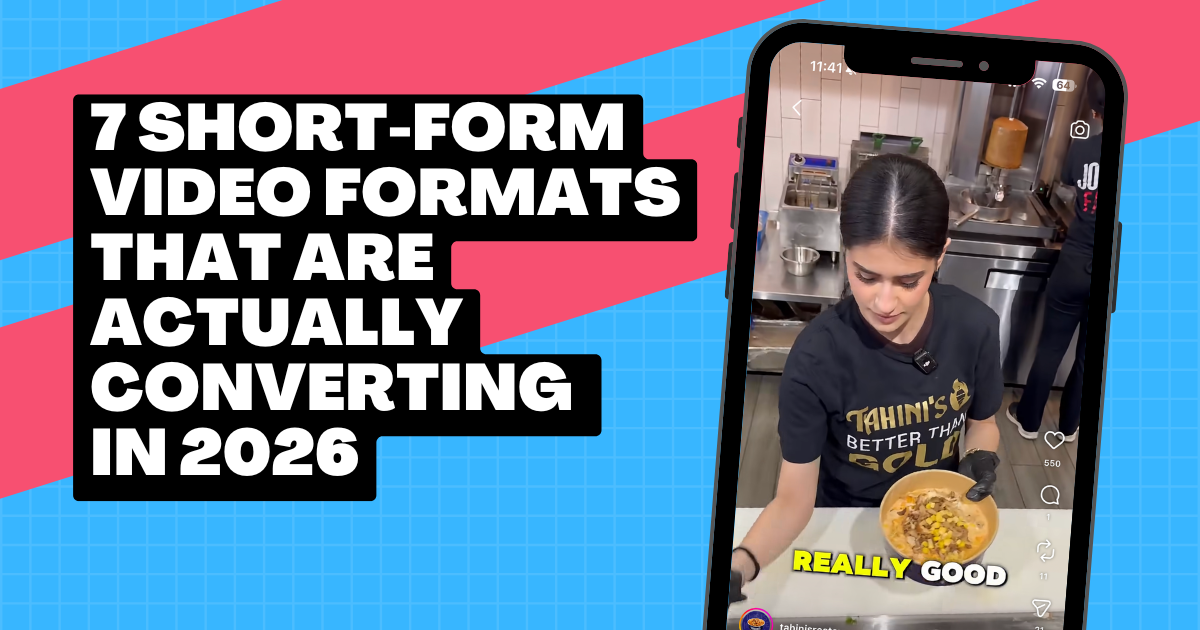
That's how we've helped brands like Tahini's generate 75M+ views every three weeks. Not by shooting more. By knowing exactly what to keep and what to delete.
The system does the thinking. The content does the performing.
Q: How do I know when I've cut too much from a video?
A: If the viewer can't understand the core message or call to action, you've overcorrected. The goal is to remove everything that doesn't serve the hook, the story, or the conversion — not to make the video incomprehensible. Test it on someone outside your team. If they get it in one watch, you're good.
Q: What's the best way to make ads feel platform-native without looking gimmicky?
A: Borrow UI elements and visual language that already exist on the platform (cursors, comment overlays, native text styles), but don't overdo it. One or two platform-specific touches make the content feel organic. Five make it feel like you're trying too hard. Study what's already working in your niche and adapt, don't copy.
Q: Should I shoot in 4K even if I'm posting to social media?
A: No. Most social platforms compress video heavily, so 4K doesn't translate to better performance. Shoot in 1080p, invest in better lighting and sound, and use the extra rendering time to batch more content. Volume and consistency beat resolution.
Q: How do I improve lighting on a tight budget?
A: Start with natural light near a window, then add a $30 softbox or ring light to fill shadows. Use a white poster board as a bounce to create separation from the background. You don't need a three-point lighting setup to make content look professional — you just need to control the light you have.
Q: What's the biggest mistake brands make when editing short-form content?
A: They treat it like long-form content that's been chopped down. Short-form isn't a highlight reel. It's a different format with different rules. The biggest mistake is lingering on shots, adding unnecessary context, or trying to cram a full brand story into 15 seconds. Cut to the hook, deliver the payoff, end it. Anything else is friction.
The best content isn't the content with the most. It's the content with the least — the least friction, the least wasted time, the least distance between the hook and the payoff.
In 2026, attention is the scarcest resource in marketing. Every second you keep someone watching is a second you earned by cutting everything that didn't matter.
If you're still padding intros, holding on product shots, or explaining context no one asked for, you're not creating content. You're creating reasons for people to scroll past you.
The delete button is your best creative tool. Use it.
If you want a content system that's built around performance, not polish — one that knows what to cut before you even hit record — talk to Storybox. We'll help you build a repeatable content engine that turns attention into revenue, one ruthlessly edited video at a time.