Your video just hit 100K views. Your sales stayed flat.
You're not alone — and it's not because your product is wrong. It's because your content strategy stops at attention instead of converting it.
Most brands treat views like victories. Then they wonder why their TikTok has a million followers but their revenue looks the same. The gap between content that gets watched and content that gets bought isn't luck. It's structure.
Here's what's actually happening: you're creating entertainment when you need to be creating a conversion engine. And the fix doesn't take six months of testing. It takes 30 days of intentional adjustments to three core areas.
Views are a vanity metric. So are likes. Even followers don't matter if they never buy.
The brands that win with content aren't the ones with the biggest audience. They're the ones with the highest conversion rate from viewer to customer. That means every piece of content needs to do more than get watched. It needs to move someone closer to a purchase decision.
According to Sprout Social's 2026 Index, 68% of consumers say they've purchased from a brand after seeing their content on social media. But here's the catch: those purchases didn't come from random viral moments. They came from brands that intentionally built content systems designed to convert.
Most content fails because it's built around one goal: go viral. But virality without intent is just noise. You need content that compounds toward revenue, not just reach.
Here's what conversion-focused content actually looks like:
Hooks that speak directly to a problem your product solves
Not "watch me do this trend" — but "here's how this solves the exact problem you're dealing with."
Clear CTAs that tell people exactly what to do next
Not hoping they'll figure it out — but directing them to link in bio, website, or specific product.
A content mix that educates, builds trust, and asks for the sale in the right sequence
Not every video asking for a purchase — but a strategic flow that warms people up before converting them.
Repeatable formats that let you test and optimize based on what converts, not just what gets views
Not guessing what works — but tracking which content types drive actual revenue and doubling down.
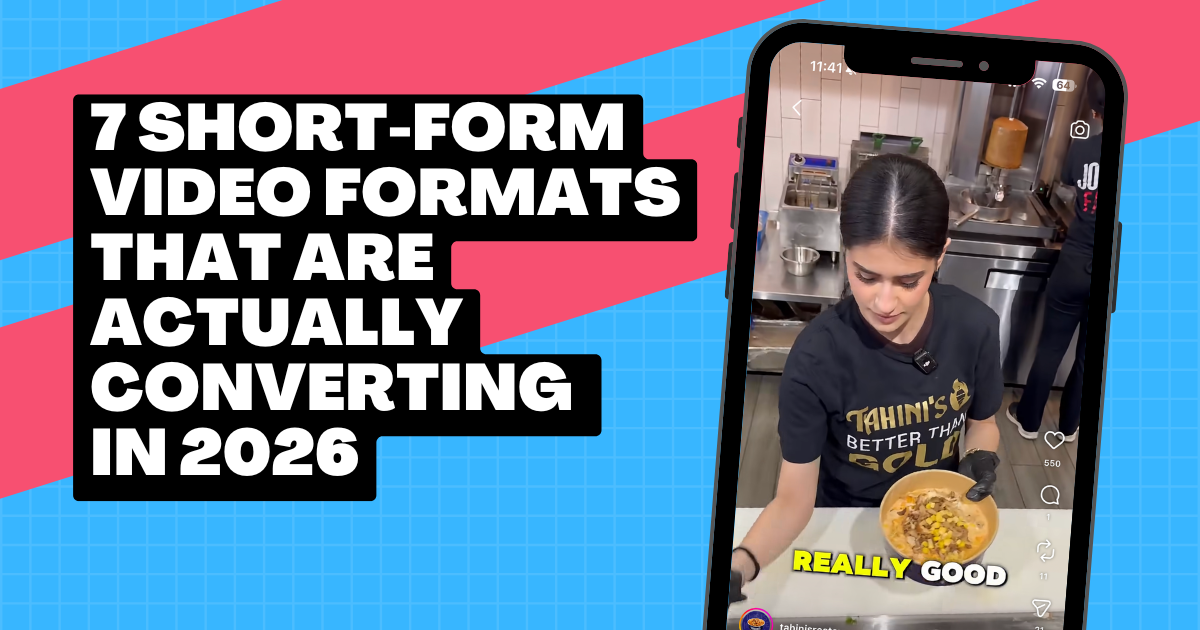
When Storybox helped Tahini's scale to 75M+ views every three weeks, the views weren't the goal. The goal was turning attention into store traffic, online orders, and brand loyalty. The views were just proof the system worked.
Let's break down the three most common reasons your content isn't driving revenue.
Most brands open videos with humour, trends, or random attention grabs. That works for views. It doesn't work for conversions.
A hook designed for conversion does two things:
Identifies a specific problem your audience has
Not "here's something funny" — but "if you're struggling with X, here's what's actually causing it."
Promises a solution they can get from you
Not vague inspiration — but a clear outcome tied to your product or service.
Example:
❌ Bad hook: "POV: you're trying to film content"
✅ Good hook: "Your restaurant is posting 3x a week and still not getting customers — here's what you're missing"
The first hook might get views. The second hook gets clicks from people who actually need what you sell.
Look at how Duolingo balances entertainment with intent. Yes, they use trends and humour. But every video reinforces one message: learning languages is easier (and more fun) with their app. The entertainment is the vehicle. The conversion is the destination.
Most videos end with no ask. Or worse, a vague "follow for more."
That's not a CTA. That's a missed opportunity.
According to HubSpot's 2026 Video Marketing Report, videos with clear CTAs convert 3.2x better than videos without them. But only 34% of brands consistently include CTAs in their short-form content.
Here's what a real CTA looks like:
Direct: "Link in bio to order"
Specific: "DM us 'MENU' to see our full selection"
Time-bound: "Use code SPRING26 this week only"
Action-oriented: "Save this and try it tomorrow"
Your audience doesn't know what to do unless you tell them. And if you don't tell them, they scroll past and forget you existed.
Gymshark is a masterclass in CTA execution. Almost every Reel ends with a product tag, a swipe-up link, or a "shop now" overlay. They don't rely on passive discovery. They actively guide viewers toward purchase.
Most brands post whatever feels right in the moment. A product demo here. A trending sound there. A behind-the-scenes video because it's Thursday.
That's not a strategy. That's content chaos.
Conversion requires sequencing. You can't ask someone to buy in the first video they see from you. You need to warm them up first.
Here's the content mix that actually converts:
60% educational/value-driven content (solves a problem, answers a question, teaches something useful)
30% trust-building content (behind-the-scenes, social proof, customer results)
10% direct conversion content (product demos, offers, clear sales asks)
This ratio ensures you're building an audience that trusts you before you ask them to buy. And when you do ask, they're already primed to convert.
When Later analyzed 2026 Instagram performance data, they found that brands with a balanced content mix saw 4.7x higher conversion rates than brands that only posted promotional content. The lesson: people need to know you, like you, and trust you before they'll buy from you.
This isn't theory. It's the exact framework Storybox uses to help brands build content engines that convert consistently, not randomly.
Here's how to turn your content into a revenue driver in 30 days.
Go through your last 20 videos. Ask:
Rewrite every hook that doesn't pass all three tests. Problem-first hooks convert. Trend-first hooks don't.
No more videos without a clear next step. Every piece of content needs to tell viewers exactly what to do.
Test different CTA types:
Track which CTAs drive the most profile visits, link clicks, and actual conversions. Double down on what works.
Map out the next 30 days of content using the conversion mix:
This sequencing ensures you're building trust before asking for the sale. And when you do ask, your audience is ready.
Stop celebrating views. Start tracking:
Use Later, Sprout Social, or native platform analytics to tie content performance to revenue. What gets measured gets optimized.

Let's say you're a restaurant posting content on TikTok and Instagram.
Before the framework:
After the 30-day framework:
Result:
That's what happens when you stop chasing views and start building a conversion system.
This is exactly how Storybox structures content for clients. Not one-off viral moments. Repeatable formats designed to guide viewers from attention to action.
The lift isn't immediate — it compounds as trust builds and the algorithm learns which audiences convert.
Even with the framework, most brands still make these mistakes:
Asking for the sale too early
You can't convert cold traffic. Warm them up first with educational and trust-building content.
Copying viral content without adapting it to your product
Trends are tools, not strategies. Use them to deliver your message, not replace it.
Ignoring the data
If a video gets 10K views but zero link clicks, it's not performing. Optimize for conversions, not impressions.
Posting inconsistently
Conversion systems require volume. You can't test and optimize with 2 videos a month.
Using generic CTAs
"Link in bio" works. "Link in bio to get 20% off your first order" works better.
Consistency and iteration beat perfection.
How long does it take to see conversions from content?
Most brands see measurable lift in 30-45 days if they're posting consistently (12-20 videos per month) and following the 60/30/10 content mix. The key is volume and iteration — you need enough content to test what converts and enough time for the algorithm to learn which audiences respond.
Should every video include a CTA?
Yes. Even educational content should guide viewers somewhere — save this, share with someone, follow for part 2, or visit link in bio for the full guide. A CTA doesn't always mean "buy now." It means "do this next." Every video should move someone one step closer to conversion.
What's the difference between viral content and conversion content?
Viral content is designed to get maximum reach and views, often through entertainment, trends, or broad appeal. Conversion content is designed to attract a specific audience with a specific problem and guide them toward a specific action. Viral content casts a wide net. Conversion content casts the right net.
How do I know which content is actually driving sales?
Use UTM links in your bio, unique promo codes per video, DM keywords, or platform-specific conversion tracking like Meta Business Suite or TikTok Analytics. Track which videos drive profile visits, link clicks, and purchases. Then make more content like that.
Can I still use trends if I'm focused on conversions?
Absolutely. Trends are distribution tools. Use trending sounds, formats, and hooks to get views — but adapt the content to your product and always include a CTA. The trend gets attention. Your message converts it.
Views don't pay the bills. Conversions do.
Most brands are stuck chasing virality when they should be building a content system that consistently turns attention into revenue. The difference isn't more budget or better equipment. It's structure.
Fix your hooks. Add strategic CTAs. Build a content mix that educates, builds trust, and converts in the right sequence. Track what actually matters. Do that for 30 days and your content will start working like a revenue engine instead of a vanity metric.
If you need help building a repeatable content system designed to convert, Storybox specializes in exactly that — high-volume, high-performing content that drives real business outcomes, not just social media numbers.