Social media marketing pricing is all over the map.
Some agencies charge $2,000 per month for "content management." Others charge $15,000 for what looks like the same scope. Freelancers quote $500. An in-house hire costs $60,000 to $100,000 per year in salary before you have paid for a single camera, editor, or hour of studio time.
Here is the problem. Pricing without output is just overhead.
Most brands do not have a pricing problem. They have a throughput problem. They are paying for posts instead of outcomes, buying deliverables instead of systems, and measuring cost per month instead of cost per result.
So let's reframe the question. Instead of "what does social media marketing cost," ask "what does one piece of performing content cost me, and how many of them do I get?"
That question changes which model wins.

What's included:
What's missing:
Traditional agencies were designed for brand awareness in a paid-first world. They deliver polished grid posts and quarterly decks. If your goal is reach and conversion, you are paying premium rates for the wrong service, and you are usually paying a subcontractor markup on the only part that actually moves the number.
What's included:
What's missing:
Freelancers are a reasonable way to test whether content matters to your business. They are not a way to scale once you have the answer.
What's included:
What's missing:
In-house works well once you already have a production system feeding it. As the system itself, it fails predictably.
%%CHART%%eyJ0eXBlIjoiYmFyIiwidGl0bGUiOiJBdmVyYWdlIE1vbnRobHkgQ29zdCBieSBTb2NpYWwgTWVkaWEgTWFya2V0aW5nIE1vZGVsICgyMDI2KSIsIm5vdGUiOiJJbGx1c3RyYXRpdmUgYmVuY2htYXJrIGJhc2VkIG9uIGluZHVzdHJ5IGF2ZXJhZ2VzLiBDb3N0cyB2YXJ5IGJ5IHNjb3BlLCBwbGF0Zm9ybSBtaXgsIGFuZCBjb250ZW50IHZvbHVtZS4iLCJkYXRhIjpbeyJsYWJlbCI6IkZyZWVsYW5jZXIiLCJ2YWx1ZSI6MzAwMH0seyJsYWJlbCI6IlRyYWRpdGlvbmFsIEFnZW5jeSIsInZhbHVlIjoxMjUwMH0seyJsYWJlbCI6IlBlcmZvcm1hbmNlIEFnZW5jeSIsInZhbHVlIjo4MDAwfSx7ImxhYmVsIjoiSW4tSG91c2UgKG1vbnRobHkgZXF1aXYuKSIsInZhbHVlIjo3NTAwfV19%%
What's included:
What's different:
This is the model Storybox runs.
Pricing models have not caught up to how the platforms actually work.
Most agencies still price like it is 2018. They sell "social media management" the way they sold Facebook ad management, as a monthly service fee attached to a small number of polished deliverables. But the formats changed, the discovery mechanics changed, and the volume required to earn distribution changed.
Here is the part worth being precise about, because a lot of agency marketing gets it wrong: posting more is not automatically better. Sprout Social's own benchmark research has pointed the other direction, noting that scaling back publishing volume can create room for higher-value content, and that people weigh originality and interaction more heavily than raw post count when deciding to follow a brand.
That is true, and it is not an argument against volume. It is an argument against volume without a system.
The real mechanism is testing. Every piece you publish is a test. If you publish 12 times a month, you run 12 tests. If you publish 40 times, you run 40. More tests means faster identification of the formats that work for your specific audience, which means the next batch is built on evidence instead of instinct. That is what "content compounds" actually means. It is not that the algorithm rewards you for showing up. It is that you learn faster than your competitor does.
Traditional agencies cannot run 40 tests a month at a defensible cost per asset. So they sell strategy instead of execution, and talk about brand voice while your competitor iterates their way to a format that prints reach.
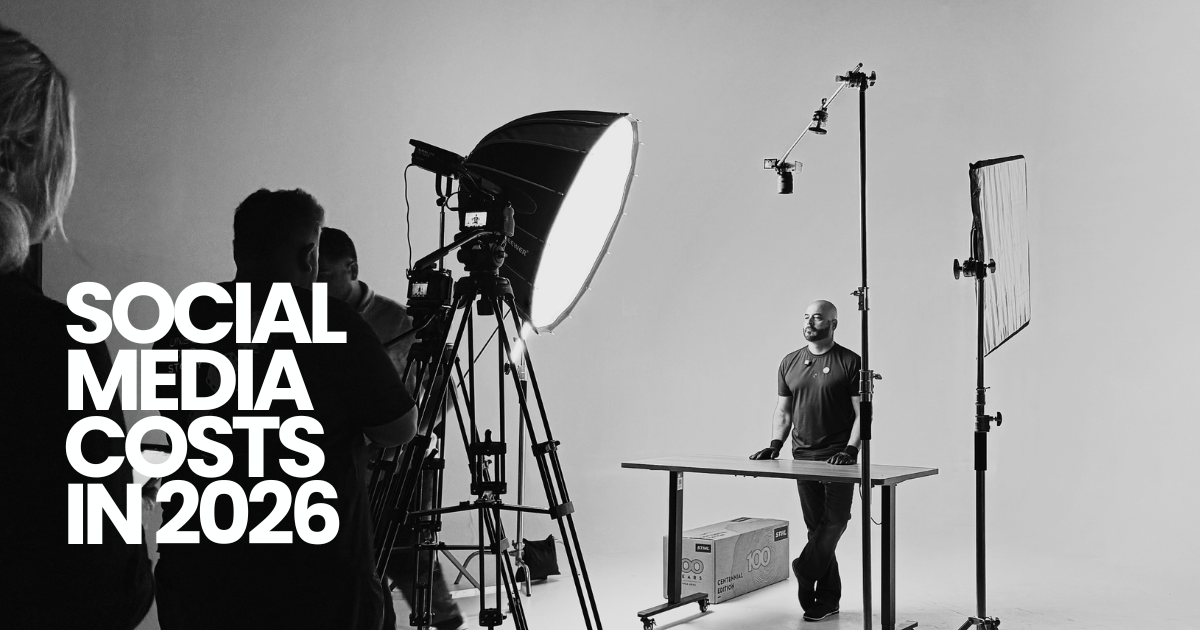
Ask any agency quoting you a shoot whether they own their equipment. Most do not. Camera packages, lighting, audio, and grip get rented per day and marked up before it hits your invoice. On a monthly filming cadence, that line item alone can add thousands per month for equipment you never see.
Storybox owns its full production package outright. Our quotes do not carry a gear rental line.
This is the cost that never appears in the pricing comparison, and it is often the largest one. If content does not earn distribution on its own, the only way to get it seen is to pay for it. A $6,000 content retainer that requires $10,000 in paid support to hit its reach target is a $16,000 program.
The alternative is content built to earn reach without the media buy. That is the entire basis of our case studies below, and it is the number we would push you to interrogate with any agency you are evaluating.
Agency rates in Toronto and Vancouver carry downtown overhead, and that overhead is priced into your retainer whether or not it improves your content. Storybox operates out of London, Ontario. Same crew quality, same equipment, same output, materially lower cost base. For clients in Southwestern Ontario and the GTA, we are a drive away. For everyone else, we travel, and the travel is still cheaper than the rate difference.
If your agency takes 2 to 4 weeks from concept to publish, the moment is gone before the video is live. Anything slower than 48 to 72 hours on time-sensitive content is reach you paid for and did not receive.
Two posts one week and zero the next resets whatever momentum you built. Consistency is a production capacity question, not a discipline question, and it is exactly where thin teams break.

If you are getting fewer than 12 pieces per month at any price above $5,000, you are funding strategy and paying production rates for it.
Five questions. Ask them of every agency on your list, including us.
1. What is my cost per asset?Divide the retainer by the monthly output. Then ask what that number buys elsewhere. This single calculation eliminates most of the shortlist.
2. Do you own your equipment, or are you renting and marking it up?Owned gear means the cost of an additional shoot day is crew and time, not crew, time, and a rental invoice. It is the difference between a studio and a middleman.
3. What does the paid media budget need to be for this to work?If the answer is anything other than "optional," add it to the retainer and recalculate. Ask for case studies where reach was earned organically.
4. How fast do you turn around a piece of content?Concept to published. If it is over a week, momentum is not part of what you are buying.
5. Are your formats repeatable, or is every video a custom project?Custom projects do not scale and do not compound. Repeatable frameworks do. Ask to see the same format applied across a dozen videos with the performance data attached.
Short-form video is where the return is concentrated. HubSpot's 2026 State of Marketing Report has marketers naming short-form video as the highest-ROI content format, and it was the most used format overall at 60 percent adoption. If an agency's short-form capability is a secondary offering, their pricing is built around something you are not buying.
We do not sell strategy decks. We sell production systems.
The through-line is not luck and it is not budget. It is the same production system applied at volume, with formats that carry from one client to the next and get sharper each time we run them.
Watford Ford matters more than the big numbers, honestly. A dealership in a small Ontario town hitting 600,000 organic views on its first three posts is the proof that this is a system, not a case of getting lucky with brands that were already interesting.
You can pay $2,000 a month or $20,000 a month. If the output is thin, the turnaround is slow, and the content needs paid support to get seen, you are overpaying at either number.
The right question is not "how much does social media marketing cost." It is:
What am I paying per piece of content, how fast does it ship, and does it earn reach without a media buy behind it?
If you are ready to move from sporadic posts to a system that produces at volume and improves with every batch, let's talk. We will run the cost-per-asset math with you on the call, including against whoever else you are considering.
How much should I budget for social media marketing in 2026?
For most growth-focused brands, $6,000 to $15,000 per month buys a real production system: weekly filming, 20 to 40+ videos per month, and platform-native short-form across TikTok, Reels, and Shorts. Budgets of $3,000 to $5,000 work for testing but rarely sustain the cadence needed to build momentum. Whatever tier you land in, divide by monthly output and compare the per-asset number rather than the retainer.
What's the difference between a traditional social media agency and a performance content studio?
Traditional agencies sell strategy, community management, and 12 to 20 posts per month, and typically subcontract the filming. Performance content studios like Storybox own the production end to end, which means higher volume, faster turnaround, no gear rental markup, and formats designed to earn organic reach rather than require paid support.
Is it cheaper to hire a freelancer or work with an agency?
Freelancers cost less upfront at $1,000 to $5,000 per month but cannot scale past roughly a dozen pieces, and your account competes with their other clients. Agencies cost more but deliver volume, consistency, and redundancy. On cost per asset, a high-volume studio frequently comes out lower than a freelancer despite the higher retainer.
How many posts per month should I get for my budget?
At $3,000 to $5,000, expect 15 to 20. At $6,000 to $10,000, expect 25 to 40. At $10,000 to $20,000, expect 40 to 60+. Volume is what generates the testing data that makes the next batch better. Under 20 pieces at a mid-tier retainer usually means you are funding strategy work.
Does location affect what I pay for a content agency?
Yes, more than most brands realize. Toronto and Vancouver agency rates carry downtown overhead that is priced into your retainer regardless of whether it improves the work. Studios based outside the major centres, like Storybox in London, Ontario, run a materially lower cost base for the same crew and equipment quality.
What should I look for when evaluating social media marketing pricing?
Cost per asset, turnaround time, whether the agency owns its equipment, whether formats are repeatable, and how much paid media the plan quietly assumes. Push past engagement rate as a success metric and ask for views, reach, and conversion data from named clients.