Most brands post content like they're throwing darts blindfolded. A product demo here. A trending audio there. Maybe a behind-the-scenes video if someone remembers to film it.
The result? Inconsistent reach. Burnt-out teams. Zero compound effect.
Here's what works instead: repeatable formats. Not one-off ideas. Not "let's see what sticks." Actual content structures you can film weekly, optimize monthly, and scale without reinventing the wheel every time.
In 2026, Storybox used seven core formats to drive over 1M views for clients across restaurants, retail, and B2B. These formats aren't theoretical. They're the exact structures we script, film, and optimize every week.
Let's break them down.
What it is: A fast-paced montage showing what a typical day looks like for your team, your product, or your customer. Think: kitchen prep, inventory unboxing, order fulfilment, or a service technician's morning routine.
Why it works in 2026: TikTok and Instagram algorithms favour watch-through rate. Day-in-the-life content keeps people watching because it satisfies curiosity without requiring a punchline. According to Hootsuite's 2026 Social Trends Report, behind-the-scenes content drives 34% higher engagement than polished ads.
Script structure:
Performance benchmark: 200K-800K views per post for restaurant and retail clients.
Pro tip: Film these in batches. One morning of filming can give you 4-6 weeks of content.
What it is: Recording real or recreated sales calls, customer service interactions, or consultations and turning them into educational, personality-driven content.
This format became a breakout performer in 2026. For one B2B client, a single video showcasing a typical sales call became a repeatable format that consistently generates 1M+ views every time we post it.
Why it works: People love watching experts handle objections, explain value, or navigate tricky conversations. It's educational without feeling like a lecture. Plus, it humanises your brand in a way product demos can't.
Script structure:
Performance benchmark: 1M+ views per post when executed consistently.
Pro tip: You don't need real calls. Recreate common scenarios with your team. The authenticity comes from the insight, not the production value.

What it is: Before-and-after content showing a clear visual transformation. Works for food (raw ingredients to plated dish), retail (product unboxing to styled outcome), or service (messy problem to clean solution).
Why it works: Transformation content triggers curiosity and completion bias. Viewers want to see the end result, which drives watch-through rate — a critical ranking signal for YouTube Shorts and Reels in 2026.
Script structure:
Performance benchmark: 400K-900K views for product-based brands.
Pro tip: Speed up the process. Nobody wants to watch a 45-second transformation. Keep it under 15 seconds.
What it is: Your team reacting to common customer mistakes, viral trends in your industry, or competitor content. Think: a chef reacting to a TikTok cooking hack, a mechanic reviewing a car care myth, or a marketer breaking down a bad ad.
Why it works: Reaction content benefits from borrowed interest — you're commenting on something people are already talking about. It also positions your brand as an authority without being preachy. Sprout Social's 2026 Index found that reaction-style content drives 28% more shares than standard educational posts.
Script structure:
Performance benchmark: 300K-700K views, with higher save rates.
Pro tip: Don't just criticise. Offer the fix. That's what gets saved and shared.
What it is: Content filmed from the customer's perspective. A restaurant showing the diner's view of a dish being plated. A car dealership filming a test drive from the driver's seat. A retail brand showing the unboxing experience.
Why it works: POV content creates immersion. It puts the viewer in the experience, which increases emotional engagement and makes the content feel less like an ad.
Script structure:
Performance benchmark: 250K-600K views, with strong conversion rates when paired with clear CTAs.
Pro tip: Use first-person captions ("I just walked in and...") to make the POV feel even more authentic.
What it is: Taking a trending audio, meme format, or viral hook and adapting it to your industry. Not copying — adapting with context that makes sense for your brand.
Why it works: TikTok's algorithm in 2026 still prioritises trending sounds and formats because they signal cultural relevance. Brands that jump on trends early (within 48-72 hours) see 3-5x the reach of evergreen content posted the same week.
Script structure:
Performance benchmark: 500K-1.5M views when executed within the trend window.
Pro tip: Don't overthink it. Trends move fast. Film it, post it, move on. Speed beats polish here.

What it is: Debunking a common misconception in your industry. "You think X, but actually Y." Works for food safety myths, car maintenance lies, marketing misconceptions — anything with a gap between belief and reality.
Why it works: Myth-busting content performs because it creates a knowledge gap that viewers want closed. It also positions your brand as the authority who knows better than the internet noise.
Script structure:
Performance benchmark: 400K-900K views with high save and share rates.
Pro tip: Be specific. "Stop wasting money on social media ads" is vague. "Stop boosting posts on Instagram — here's what actually works" is a myth people will click.
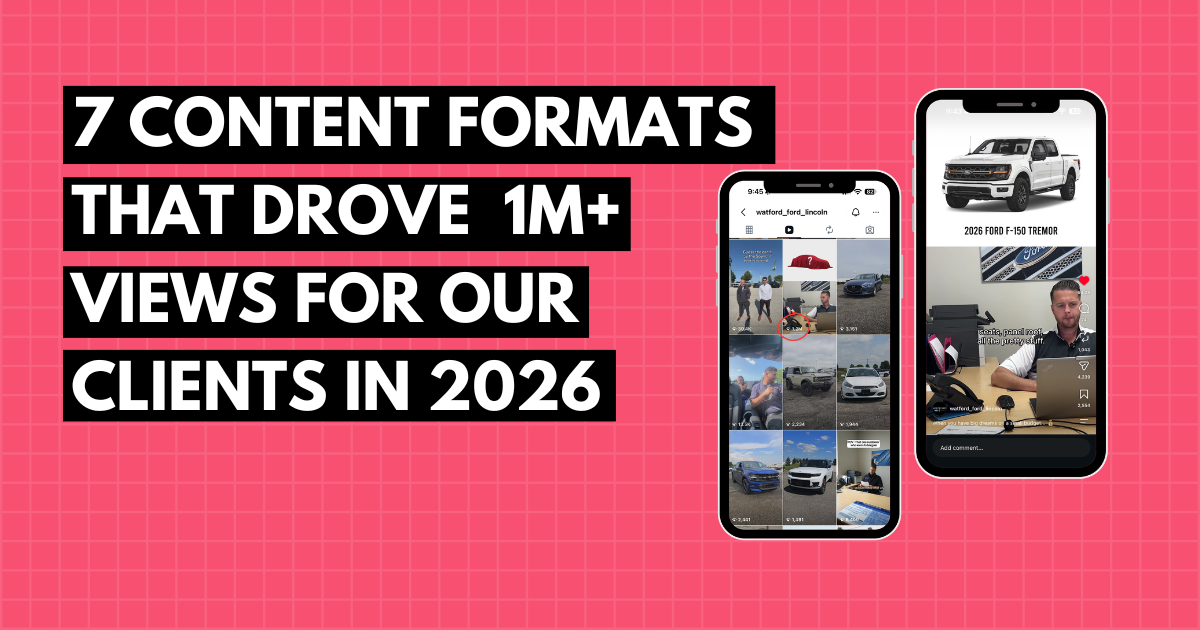
We partnered with Watford Ford to launch a social-first video content engine. The goal: turn their inventory, team, and customer moments into scroll-stopping short-form content that builds local brand awareness fast.
How it works:
The results (just 2 weeks in):
This wasn't luck. It was formats 1, 2, and 5 applied to a local dealership with zero previous social presence. The content system works because it's built to repeat, not reinvent.
Not every content idea is a format. A format has three characteristics:
1. It has a structure. You can template the hook, the body, and the payoff. You're not starting from scratch every time.
2. It's platform-native. It works with how people scroll, watch, and engage on TikTok, Reels, and Shorts — not against it.
3. It compounds. Each execution teaches you what works, so the next one performs better. You're optimising a system, not gambling on ideas.
The seven formats above check all three boxes. That's why they drove 1M+ views in 2026 while other brands were still "brainstorming creative."
What's the difference between a content format and a content idea?
A content idea is a one-time concept ("let's film our founder's morning routine"). A content format is a repeatable structure you can execute weekly ("day in the life of [X role]" filmed with different team members every week). Formats scale. Ideas don't.
How do I know which format will work for my brand?
Start with what you can film easily and consistently. If you're a restaurant, day-in-the-life and product transformation formats are low-hanging fruit. If you're B2B, sales call and myth buster formats work best. Test 2-3 formats for 4-6 weeks and track performance.
Can I use the same format every week without boring my audience?
Yes. Audiences don't get bored of formats — they get bored of bad execution. Look at how MrBeast uses the same challenge format repeatedly or how Duolingo leans into the same mascot-driven humour. Consistency builds recognition, which builds trust.
How long does it take to see results from repeatable formats?
Watford Ford saw 600K views in 2 weeks. Most clients see traction within 4-6 weeks of consistent posting (3-5 times per week). The key is volume and optimization. One post won't prove anything. Twelve posts will.
Do I need a big production budget to execute these formats?
No. Most of these formats perform best when they feel raw and authentic, not polished. A smartphone, natural lighting, and good editing (captions, pacing, music) will outperform expensive production that feels like an ad. Tools like CapCut and Canva make editing accessible for any budget.
Most brands are stuck in a cycle of random content that never builds momentum. They post when inspired, chase trends they don't understand, and wonder why nothing compounds.
Storybox doesn't work that way. We build content systems using repeatable formats that drive measurable results — 1M+ views, massive follower growth, and real business outcomes like leads and sales.
If you're ready to stop guessing and start scaling, let's talk about building a content engine that actually works.